Do All Playing Cards Follow One Universal Pattern?
No. A familiar pack of 52 cards—with hearts, diamonds, clubs and spades, numbered cards and court cards—is one influential convention, but it is not a universal pattern. Playing cards have varied across regions, periods and games. The pack used at a casino table is shaped by practical choices as well as inherited customs: what players need to recognise, how cards are handled, and how results are recorded.
That distinction matters when looking at casino history. A card is not just an image or a symbol. It is a small piece of equipment used within a set of rules, among other objects: a table, a layout, a shoe or dealing device, and sometimes a discard tray. The printed faces show one visual convention. The actions at the table reveal how that convention works in practice.
A familiar pack, not a universal one
Many people picture a standard deck as 52 cards divided into four suits, each containing cards from ace to king. This is commonly called a French-suited pack, after the suit signs that became familiar in France and spread widely through printing, trade and play. Its hearts, diamonds, clubs and spades are now common in English-speaking countries and in many casino games.
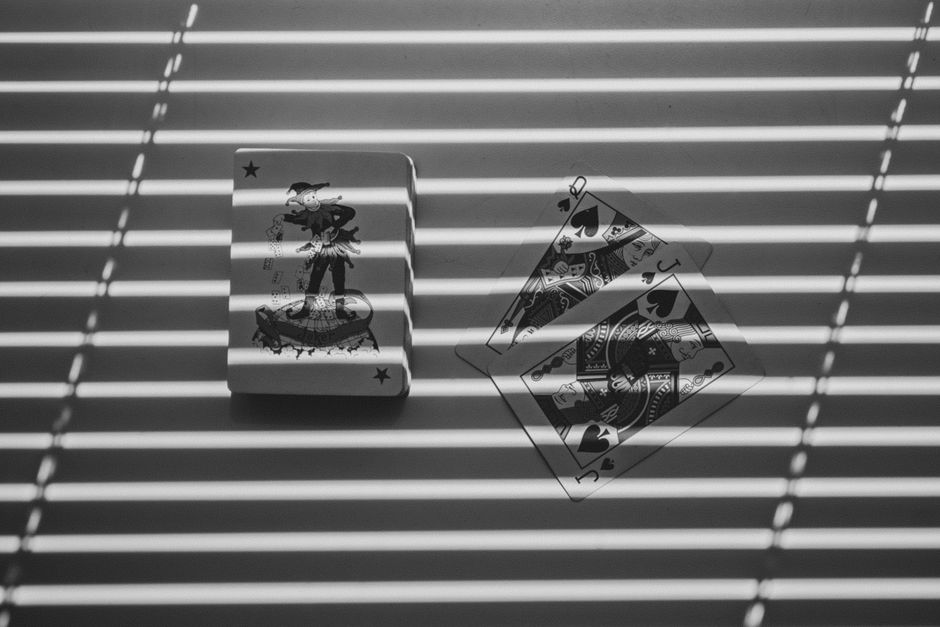
Even this familiar pattern has variations. Packs may include jokers, omit cards for particular games, or use a different number of cards. Aces can rank high, low, or change position according to the rules. Court cards—usually king, queen and jack—may be illustrated differently, and some packs use one-way designs while others are recognisable whichever way round they are held.

In other traditions, the suits themselves differ. German-suited cards commonly use hearts, bells, leaves and acorns. Swiss-suited packs may show shields, bells, flowers and acorns. Many Italian and Spanish-suited packs use signs such as cups, coins, swords and batons. These are not simply alternative pictures printed on an otherwise identical pack: the number of cards, court ranks and local game conventions may also differ.
Pack tradition Common suit signs What to keep in mind French-suited Hearts, diamonds, clubs, spades Common in many modern casino games, but pack composition and rules still vary. German-suited Hearts, bells, leaves, acorns Associated with regional games and conventions that are not identical to French-suited play. Swiss-suited Often shields, bells, flowers, acorns Regional designs and game traditions affect how the cards are read and used. Italian- or Spanish-suited Often cups, coins, swords, batons Pack sizes and court-card structures can differ from the familiar 52-card pack.The table gives broad examples, not fixed specifications. Designs differ by place and period, and names for suits or court cards can vary. “Playing cards” describes a family of objects, not one standard model.
How card traditions developed
The history of playing cards is a history of movement and adaptation. Cards travelled through trade and cultural contact, and makers adjusted designs to local tastes, materials and games. The precise routes and dates are complex; it is safer to describe a gradual history of transmission and change than to tell a neat story in which one modern pack appeared fully formed in one place.
Printed suit signs made cards easier to reproduce and recognise. In European packs, the familiar French suit symbols are often noted for their relatively simple shapes, which are economical to print and easy to distinguish at a glance. But simple signs do not make the pack culturally neutral. Suit names, court figures, colours and ranks carry histories of their own, and different communities kept different systems in use.
Tarot packs offer another reminder that there is no single template. In some contexts, tarot is a pack for card games, with a structure that includes additional trump cards. Its later association with divination is well known, but that use does not erase its history as a playing-card form. Nor should every ornate or unusual pack be treated as a standard casino deck in fancy dress: the number and function of its cards may be different.
Deck conventions are practical choices
Deck conventions are the familiar rules of construction and appearance that help players use a pack. They can include the number of cards, the order of ranks, suit symbols, face-card illustrations, corner indices and the design on the reverse. Some conventions travel widely because they are useful; others persist because players know them or because a particular game depends on them.
Recognition at a glance
Corner indices—small rank and suit marks near the corners—let a player identify a card while holding a fan of cards in one hand. Their placement is a design decision with a clear effect on handling. Large central pictures can be attractive, but they do not replace indices when a player needs to read several cards quickly without spreading them fully across a table.
Colour is also part of recognition, although it is not consistent across every design. In many modern packs, hearts and diamonds are red while clubs and spades are black. That convention can speed up visual sorting, but it should not be assumed for every historical or regional pack. A symbol’s shape, not only its colour, carries its identity.
Handling, wear and security
Cards are made to be shuffled, dealt, gathered and inspected. Their size and finish affect how easily they slide or bend. Rounded corners help distinguish a card’s intended outline from a damaged edge, while durable coatings can help cards withstand repeated use. In casinos, card backs are usually designed as a matching set so a face-down card does not reveal its identity. That visible uniformity is a convention serving a practical purpose.
Handling also affects the order of play. A dealer may deal cards from the hand, from a shoe or by another approved method, depending on the game and venue. A shoe is equipment, not a property of the deck itself. Similarly, a cut card or discard tray belongs to a table procedure: it helps manage the pack or used cards, but does not change what the printed suits mean.
Cards work within a larger piece of equipment
Casino objects make most sense in relation to one another. A pack, a dealer’s hands and the table layout form a working arrangement. In blackjack, cards are dealt to positions at a table where each player’s hand and the dealer’s hand can be read and compared. The layout marks where bets go; the cards determine hand values under the game’s rules. The felt is not merely decoration—it helps organise actions and make them legible.
At baccarat, the visual layout and dealing procedure likewise help distinguish player and banker positions, while the rules determine how many cards are dealt and when. A standard French-suited pack may be used, but the action is not identical to blackjack. The same visible object—a card with a rank and suit—takes on meaning through the game around it.
Roulette offers a useful comparison, even though it is not a card game. The wheel and the betting layout are distinct pieces of equipment. The wheel produces the result; the marked layout lets players place bets on numbers, colours, groups and other categories. Calling every roulette arrangement “the wheel” misses the functional role of the table. The same care is useful with cards: the pack, dealing device and marked areas each shape a different part of play.
Visibility and the recording of results
Casino design must make actions visible enough to be understood and results clear enough to settle bets. Cards are turned face up, placed in designated areas or held in a way that allows relevant values to be read. The table gives those actions a location. Its markings help establish where wagers belong and where cards or chips may be placed, reducing uncertainty during play.
Visibility is not the same as complete access. A live stream can show physical equipment in use: a dealer’s hands, cards being dealt, a shoe, part of a table layout and the movement of chips. This can help viewers understand the sequence of actions. But a camera shows only the angles and equipment within its frame. It may not reveal every card face, every handling detail or every procedure taking place elsewhere. What is seen is evidence of visible activity, not necessarily a full record of the system behind it.
Recording results can involve more than the cards themselves. A dealer may announce or display a result; a table procedure may settle chips; a screen may show a total or outcome. These are different layers of information. A card’s printed value is visible on its face, while the game’s rules determine what that value means in context. For example, an ace may count differently according to the game and the hand.
Physical equipment and digital representations
Animated reels are a useful contrast. A digital slot interface may show symbols moving across a screen, but that animation does not prove that physical reels are turning inside a cabinet. It is a visual representation of a result or process. The display can imitate the look of mechanical motion without documenting a mechanical mechanism.
The same caution applies to images of playing cards. A digital card on a screen may look like a printed card, but it is not being shuffled, bent or dealt as a physical object. In a physical live stream, by contrast, the viewer may see actual cards and some of the equipment used to handle them—though, again, only what the camera shows. Distinguishing representation from mechanism is essential when describing how gambling equipment works.
Digital interfaces also borrow familiar deck conventions because they are easy to recognise. Hearts, diamonds, clubs and spades can appear on screens even when no paper cards are involved. Their continued use shows the reach of the convention, not that every game relies on a physical 52-card pack.
So, do all playing cards follow one universal pattern?
No. There are influential standards, especially the French-suited 52-card pack, but playing cards have never been one unchanging, worldwide design. Suit traditions, pack sizes, ranks, court figures and handling practices vary. Even within a casino, different games can use familiar cards in different ways, with distinct procedures and table layouts.
To understand a pack, look beyond the face design. Ask what cards are present, how players identify them, how they are handled and where the historyfiles.co.uk results are recorded. Then look at the surrounding equipment: the dealing area, the table markings and any device used to hold or manage the cards. The printed pattern tells part of the story. The objects in use—and the actions they make possible—tell the rest.